Every university in India is either preparing for NAAC, going through NAAC, or recovering from it.
That sentence used to describe a 5-year cycle. In 2026, it describes every single year.
With NAAC moving to a binary Accredited or Not Accredited model, a 3-year validity period, and mandatory annual AQAR submission, the old approach to evidence is no longer viable. There is no off-season. There is no 4-year preparation window. Quality has to be built into daily operations or the institution falls behind every single year.
The cycle is familiar to anyone who has worked inside an institution. Before every submission, faculty receive requests for documentation. CO attainment records. Student progression data. Evidence of applied learning. Bloom's taxonomy distribution across courses. Teaching-learning innovation logs.
What follows is a scramble. Faculty who have been teaching, assessing and researching throughout the year now spend weeks reconstructing evidence of what happened. Spreadsheets are filled retrospectively. Data is estimated. Reports are assembled from memory.
Under a 5-year cycle, this was exhausting but survivable. Under binary accreditation with annual AQAR and AI-based DVV cross-checking against AISHE and NIRF data, it is a risk institutions can no longer afford to carry.
The evidence was always there. It existed in every classroom interaction, every assessment, every student decision. The problem is that nobody designed a system to capture it as it happened.
What Binary NAAC 2026 Actually Means for Institutions
The shift to binary accreditation is not simply a change in grading. It is a change in what is at stake.
Under the previous system, an institution with a B or B+ grade could function. It was not ideal, but it was not catastrophic. Under binary accreditation, there are only two outcomes -Accredited or Not Accredited. Not Accredited means no UGC grants, no schemes, public declaration of non-accreditation, and in states like Maharashtra, potential stoppage of admissions.
The 3-year validity period sounds like more time. It is less. With annual AQAR mandatory, institutions are under continuous scrutiny. The AI-based DVV process cross-checks SSR data against AISHE and NIRF records automatically. A mismatch is an instant red flag not a conversation to be had during a site visit, but an automated alert in a system that does not negotiate.
The institutions that will navigate binary NAAC with confidence are not the ones that prepare better documentation before each submission. They are the ones that designed their academic systems to generate accurate, verifiable evidence continuously -as a natural output of teaching and assessment that was already happening.
That is the shift. From evidence compilation to evidence generation. From a 5-year event to a daily operating standard.
The Real Cost of Manual Evidence Compilation
When evidence is compiled retrospectively, three things happen.
First, it is inaccurate. Memory is not a reliable record of learning outcomes. What a faculty member recalls about student performance across a semester is shaped by recency bias, by the students who stood out, and by what they wished had happened rather than what did. Under AI-based DVV cross-checking, inaccurate data is not just a weakness -it is a risk.
Second, it is incomplete. The most valuable evidence -how students reason, where their thinking breaks down, which concepts are understood deeply and which are memorised thinly -is invisible to any assessment that only captures the final answer.
Third, it consumes time that should be spent teaching. Every hour a faculty member spends filling evidence spreadsheets is an hour not spent on course design, student feedback, or research. Under annual AQAR, this cost is incurred every year.
The question worth asking is not how to compile evidence better. It is how to design learning systems that generate evidence automatically as a natural by-product of learning that actually happens.
CaseCrumbs™ -Evidence Generated as Learning Happens
CaseCrumbs™ is a decision-based learning platform. Short, context-rich scenarios are embedded directly into existing courses. Students engage with discipline-specific situations that require them to think, reason, apply judgment and make decisions -not recall facts.
Every interaction generates data. Not just a score. A complete record of how the student engaged with the problem.
The platform captures session and engagement data time spent, nodes visited, action sequence, reflection text, number of attempts. It captures decision-level data which option was selected, the decision score on a scale of 0 to 100, the Bloom's taxonomy level of the question, the Course Outcome and Programme Outcome tags. It captures category-level data how the student performed across dimensions of Ethics, Alignment, Trust, Risk and Data.
This data is mapped directly to NAAC criteria and exported as accreditation-ready documentation.
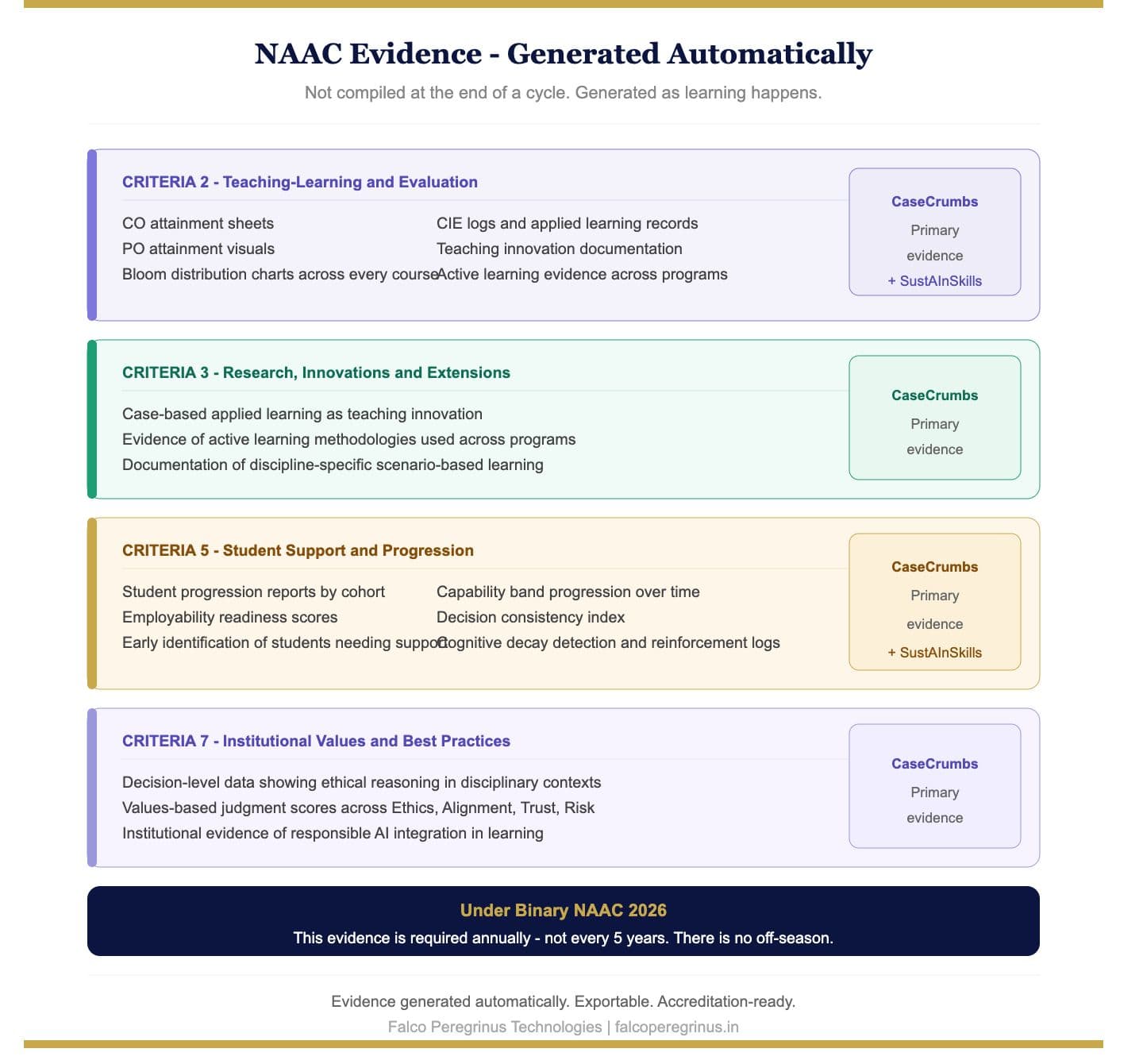
Criteria 2 -Teaching-Learning and Evaluation: CO attainment sheets, PO attainment visuals, Bloom distribution charts across the course, CIE logs, applied learning records. Generated automatically from every CaseCrumbs™ session.
Criteria 3 -Research, Innovations and Extensions: Case-based applied learning logged as a teaching innovation. Evidence of active learning methodologies used across programs.
Criteria 5 -Student Support and Progression: Student progression reports, readiness scores, cohort benchmarking, identification of students who need support before they fall behind.
Criteria 7 -Institutional Values and Best Practices: Decision-level data showing how students reason on questions of ethics, alignment and responsible judgment -embedded in real disciplinary contexts.
Critically -this data is accurate because it comes from real learning interactions, not retrospective estimation. Under AI-based DVV cross-checking, accuracy is not optional. CaseCrumbs™ generates evidence that is verifiable because it was captured at the point of learning.
SustAInSkills™ -The Evidence Layer That Shows Learning Held
NAAC assessors are not only interested in whether learning happened. They are interested in whether it stuck.
SustAInSkills™ is a capability measurement and retention platform. Where CaseCrumbs™ captures what students do in the moment, SustAInSkills™ tracks whether that capability is retained over time.
The platform measures capability across four bands -from foundational to advanced. It detects cognitive decay -the natural erosion of capability when learning is not reinforced -and triggers targeted reinforcement when a student's performance drops below their established band. Reinforcement is triggered by performance, not by a completion schedule.
For annual AQAR submissions, SustAInSkills™ generates CO and PO attainment mapping over time -not just at a single point. It produces employability readiness scores, decision consistency indices, and cohort benchmarking reports. These are exportable as accreditation documentation that shows year-on-year progression, not just a snapshot.
The combination of CaseCrumbs™ and SustAInSkills™ gives an institution something no spreadsheet can produce: a longitudinal record of how students developed capability, where they struggled, how the institution responded, and whether the response worked. Under binary NAAC with annual AQAR, that longitudinal record is exactly what separates institutions that pass consistently from those that scramble annually.
What Changes for Faculty
Faculty do not need to change how they teach to use these platforms. CaseCrumbs™ scenarios are embedded into existing LMS environments. They sit alongside existing course content. A faculty member adds a scenario the way they would add any learning activity.
What changes is what becomes visible. Faculty who use CaseCrumbs™ can see, in real time, where their students are struggling. Not at the end of the semester when the damage is done. During the semester when something can still be done about it.
They can see which concepts are understood deeply and which are held thinly. They can see how their cohort compares to previous cohorts. They can identify students who need support before those students know they need it.
The NAAC evidence is a by-product of this visibility. It is generated automatically. It is accurate because it comes from real learning interactions. And it is exportable in formats that AQAR documentation requires -every year, without the scramble.
What Changes for Institutions
For academic administrators and IQAC coordinators, the shift is from evidence compilation to evidence access.
Programme-level CO and PO attainment data across departments. Cohort comparisons year on year. Curriculum review evidence that is data-based rather than opinion-based. Visibility into which teaching approaches produce the strongest applied learners.
Under binary NAAC, this visibility is not a competitive advantage. It is a survival requirement. Institutions that cannot demonstrate continuous quality improvement with verifiable data -annually -are carrying a risk that compounds every year.
The Institutions That Will Walk In With Confidence
The next NAAC submission will come. Under binary accreditation, so will the one after that, and the one after that.
The institutions that walk into each cycle with confidence are not the ones that compile better spreadsheets in the weeks before the submission. They are the ones that designed their learning systems to generate evidence throughout the year as a natural outcome of teaching and assessment that was already happening.
That is the shift CaseCrumbs™ and SustAInSkills™ make possible. Not a compliance tool bolted onto existing systems. A learning intelligence platform that happens to also be an accreditation engine.
Faculty looking to redesign how they teach and assess for the AI era can explore the AI Faculty Transformation Lab.
From competency to capability. From compliance to evidence. That is Falco.
About Falco Peregrinus Technologies
Falco Peregrinus Technologies builds capability measurement and learning intelligence platforms for universities and corporations. CaseCrumbs™ and SustAInSkills™ are designed to generate NAAC evidence automatically as a by-product of learning that actually happens. The AI Faculty Transformation Lab supports faculty in redesigning teaching, assessment and research for the AI era.